
Holistic facade of the Breeze House in Ho Chi Minh City, Vietnam

While focusing on Vietnamese modernist and holistic architecture, architect Mel Schenck explores the intellectual force of the Information Age in developing the theory behind holistic architecture.

A form of architecture pollution has been inflicted on the Vietnamese urban environment over the past decade. It takes the form of the neoclassical style applied to urban townhouses.

These neoclassical dumps reflect absolutely no Vietnamese identity. Most importantly, they do not reflect our times today.

Almost a decade ago, in 2017, I wrote an article for Saigoneer pointing out how our values and aspirations should be expressed in our architecture.

https://saigoneer.com/vietnam-architecture/10075-opinion-saigon’s-architecture-should-express-our-times-today,-not-the-past

Faux-colonial or neoclassical architecture reflects the values of the far past. Therefore it is reactionary to use this architecture of the former colonial oppressor in a country founded upon the revolutionary struggle against colonialism and imperialism.

Today’s faux-colonial structures are often a pastiche of several stylistic elements, none of which successfully go together. It is particularly disturbing when neoclassical elements are applied to obviously modern buildings, buildings which should be modernist.
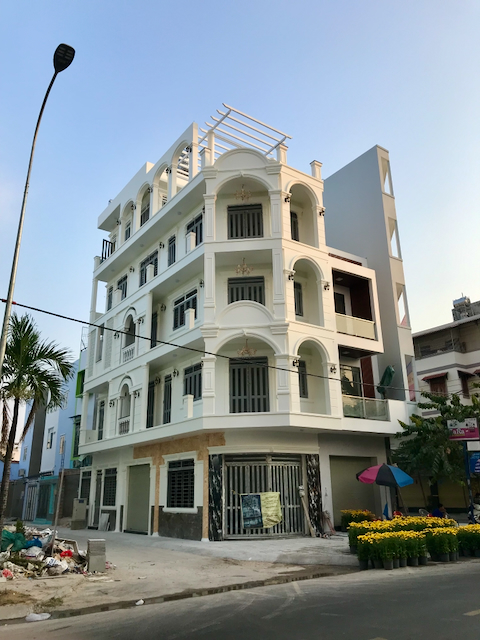
A modern building in Ho Chi Minh City, Vietnam, with improperly used neoclassical elements.

In this dog’s dinner of an example, walls which should be heavy in classical architecture are used as thin screens.
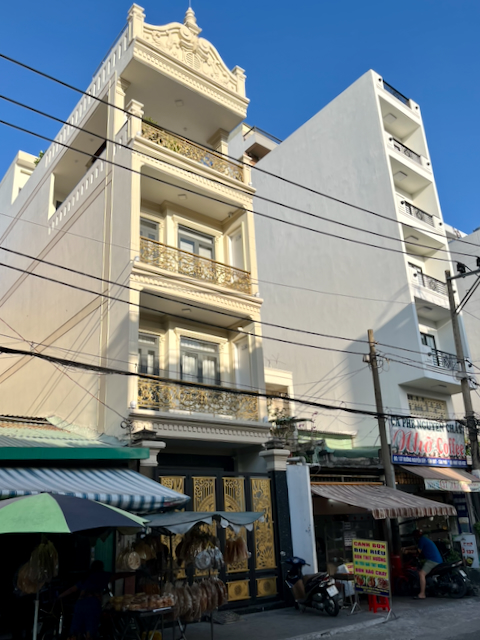
In townhouses which are structured the same as many modernist houses, as shown in this example with the modernist house on the right, the faux-colonial house is merely tarted up with neoclassical ornamentation.
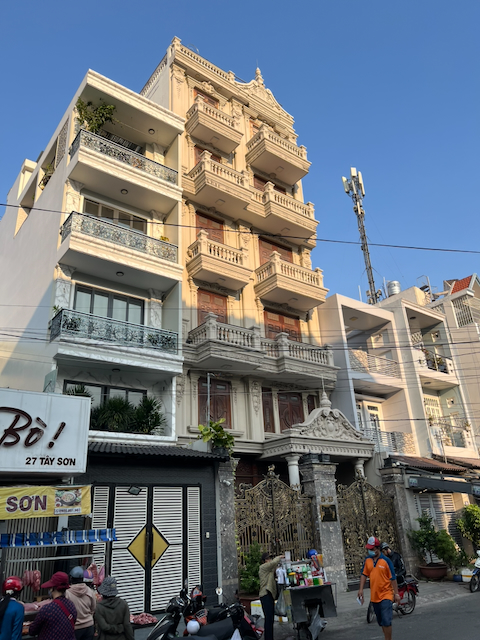
And finally, neoclassical structures in these times are most often blatantly dishonest to the principles of classical architecture. Classical architecture depends upon its technology of brick and stone, which results in heavy thick walls with lots of wall area for ornamentation. The new faux-colonial townhouses often use cantilevered balconies, which is impossible under classical architecture and therefore a feature you never see in historical examples. In addition, classical structures rarely exceeded three or four stories because the brick and stone walls would become too thick at the base and make the ground floor unusable. Therefore faux-colonial structures like this example with six floors or more are just dishonest.

Saigon’s history is enriched with the reality of its beautiful colonial buildings, so why water down that identity with poorly executed fakes? The beautiful heritage buildings of Vietnam’s colonial era should be respected, and most importantly, conserved; but, they should not be dishonored with the dishonest contemporary use of neoclassical architecture.

Go to the Facebook “Vietnamese Modernist Architecture” group

8 responses

  1. James Clark Avatar

    Thanks for technically describing this style that visually disturbs me. Another thing that bothers me is the use of the coat of arms of the United Kingdom on the gates of these houses (I think the house in the third picture has this). This style has spread across the country, and it gets worse up north where nouveau riche factory owners are building giant mansions that look like churches.

    Liked by 1 person

    1. Mel Schenck Avatar

      Does the coat-of-arms on the gates of this faux-colonial house in Ho Chi Minh City (photo by Connla Stokes) represent the UK? Gilded gates of a faux-colonial house in Vietnam

      Like

      1. James Clark Avatar

        This appears to be a continual evolution of style copied from the UK coat of arms. I found this one in Hanoi which has the elements of the arms, but with incorrect details https://photos.smugmug.com/Asia/Vietnam/Hanoi/i-b2Ht6kX/0/MfKjDwMJMv5FSNWZbbr7wnQhHzKGC286b5JcvWMwN/L/20221004_133519-coat-of-arms-L.jpg

        here is what is actually looks like
        https://en.wikipedia.org/wiki/Coat_of_arms_of_the_United_Kingdom#/media/File:Coat_of_arms_of_the_United_Kingdom_(2022,_variant_2).svg

        Liked by 1 person

  2. Alexandra van der Essen Avatar

    There’s a very interesting article by Caroline Herbelin on this topic. She interviewed homeowners of such houses in the North and apparently none of them perceive these houses as colonial or nostalgic copies of the past. For them, it’s mainly about status and a way to express a cosmopolitan identity.Here’s the link: https://journals.openedition.org/abe/392

    Liked by 1 person

    1. Mel Schenck Avatar

      This is a very good paper about the motivation for faux-colonial houses in northern Vietnam. I reference Prof. Herbelin’s paper on page 35 of my book on southern Vietnamese modernist architecture. When I published my book in 2020, the faux-colonial, or “New French Style” houses were primarily in the north. Since then, they have migrated to the south.

      Liked by 1 person

  3. Charles Cobble Avatar
    Charles Cobble

    An insightful piece on what I can understand to most is a “pseudo style”in some sense. A pastiche of fantasy badly executed… That said the Lingnan style seen in southeastern China has much of this same “borrowing” of European stylistic elements confected into odd discordant buildings as well. Yet somehow it works contextually and aesthetically. Perhaps the Overseas Chinese experience and story that makes it work and fit in despite its sometimes outlandish combinations or features. Or is it that enough time has passed that these oddities are now part of the architectural fabric? The point being that perhaps this trend will someday be part of the Vietnam story? I would bet the better examples will survive.

    Liked by 1 person

    1. Mel Schenck Avatar

      Thanks for your comment, Charles. I don’t think this trend will last much beyond another five years or so in Vietnam. This looking back to the past is a reaction to the complexity of life in the Information Age. The Vietnamese government and the people have made a serious goal to become a fully-developed country by embracing the Information Age by the mid-21st century. Vietnamese people embrace complexity of life, and Vietnamese architects are now showing the world what the holistic architecture of the Information Age is for houses and small buildings like schools.

      Like

      1. charles cobble Avatar
        charles cobble

        Yes I agree. That said I’ll bet there are a few “hidden nuggets” in the dross that 20 years on will be seen as fortunate survivors that encapsulate this period of history. It would be a shame to lose these examples. Let’s not throw out the good with the overwhelming bad. We’d not have the Lignan style here if that had happened in southeast China.

        Like

Leave a comment