

A form of architecture pollution has been inflicted on the Vietnamese urban environment over the past decade. It takes the form of the neoclassical style applied to urban townhouses.
These neoclassical dumps reflect absolutely no Vietnamese identity. Most importantly, they do not reflect our times today.
Almost a decade ago, in 2017, I wrote an article for Saigoneer pointing out how our values and aspirations should be expressed in our architecture.
Faux-colonial or neoclassical architecture reflects the values of the far past. Therefore it is reactionary to use this architecture of the former colonial oppressor in a country founded upon the revolutionary struggle against colonialism and imperialism.
Today’s faux-colonial structures are often a pastiche of several stylistic elements, none of which successfully go together. It is particularly disturbing when neoclassical elements are applied to obviously modern buildings, buildings which should be modernist.
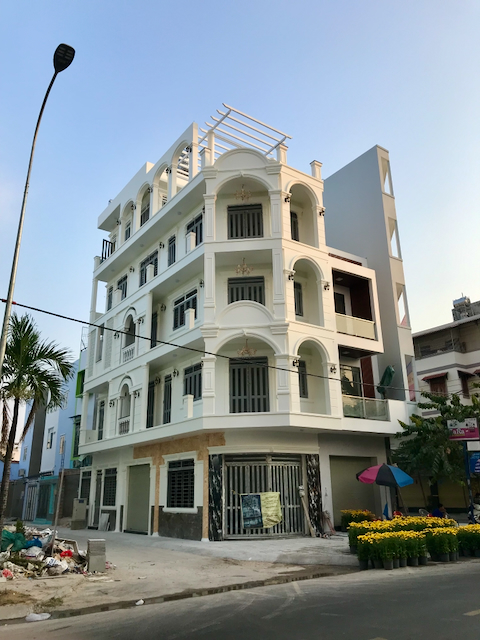
In this dog’s dinner of an example, walls which should be heavy in classical architecture are used as thin screens.
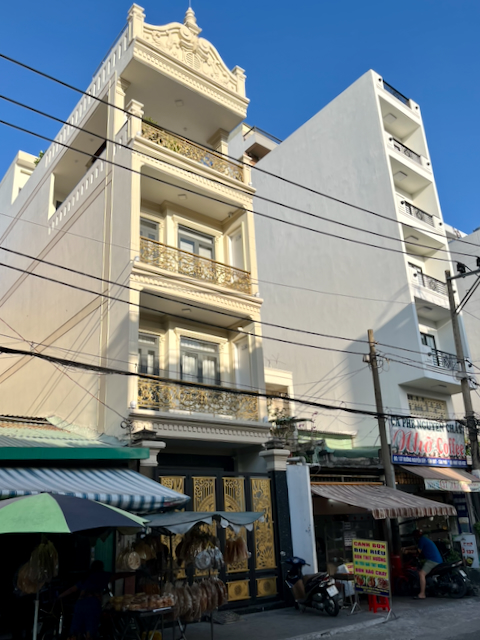
In townhouses which are structured the same as many modernist houses, as shown in this example with the modernist house on the right, the faux-colonial house is merely tarted up with neoclassical ornamentation.
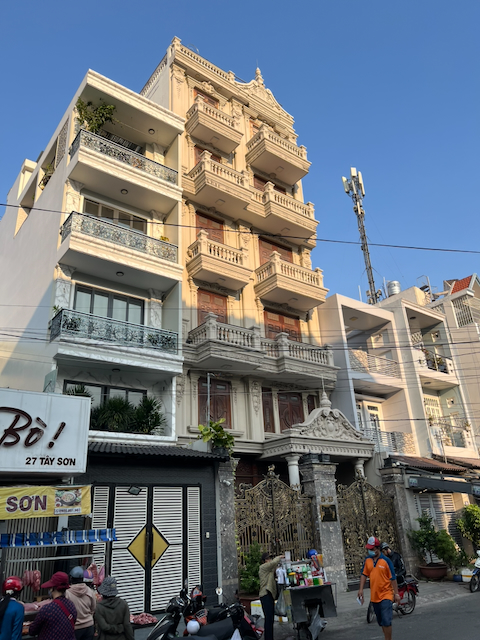
And finally, neoclassical structures in these times are most often blatantly dishonest to the principles of classical architecture. Classical architecture depends upon its technology of brick and stone, which results in heavy thick walls with lots of wall area for ornamentation. The new faux-colonial townhouses often use cantilevered balconies, which is impossible under classical architecture and therefore a feature you never see in historical examples. In addition, classical structures rarely exceeded three or four stories because the brick and stone walls would become too thick at the base and make the ground floor unusable. Therefore faux-colonial structures like this example with six floors or more are just dishonest.
Saigon’s history is enriched with the reality of its beautiful colonial buildings, so why water down that identity with poorly executed fakes? The beautiful heritage buildings of Vietnam’s colonial era should be respected, and most importantly, conserved; but, they should not be dishonored with the dishonest contemporary use of neoclassical architecture.


 Architecture Vietnam

.svg)
Leave a reply to James Clark Cancel reply